Radius, postcode or borough
How to target Greater Manchester without paying for Cheshire
Radius, postcode or borough targeting for Google Ads across Greater Manchester: the ten boroughs and their postcodes, presence settings, bid adjustments.
By Daniel Stoychev, Webso Digital · 5 September 2026 · 6 min read
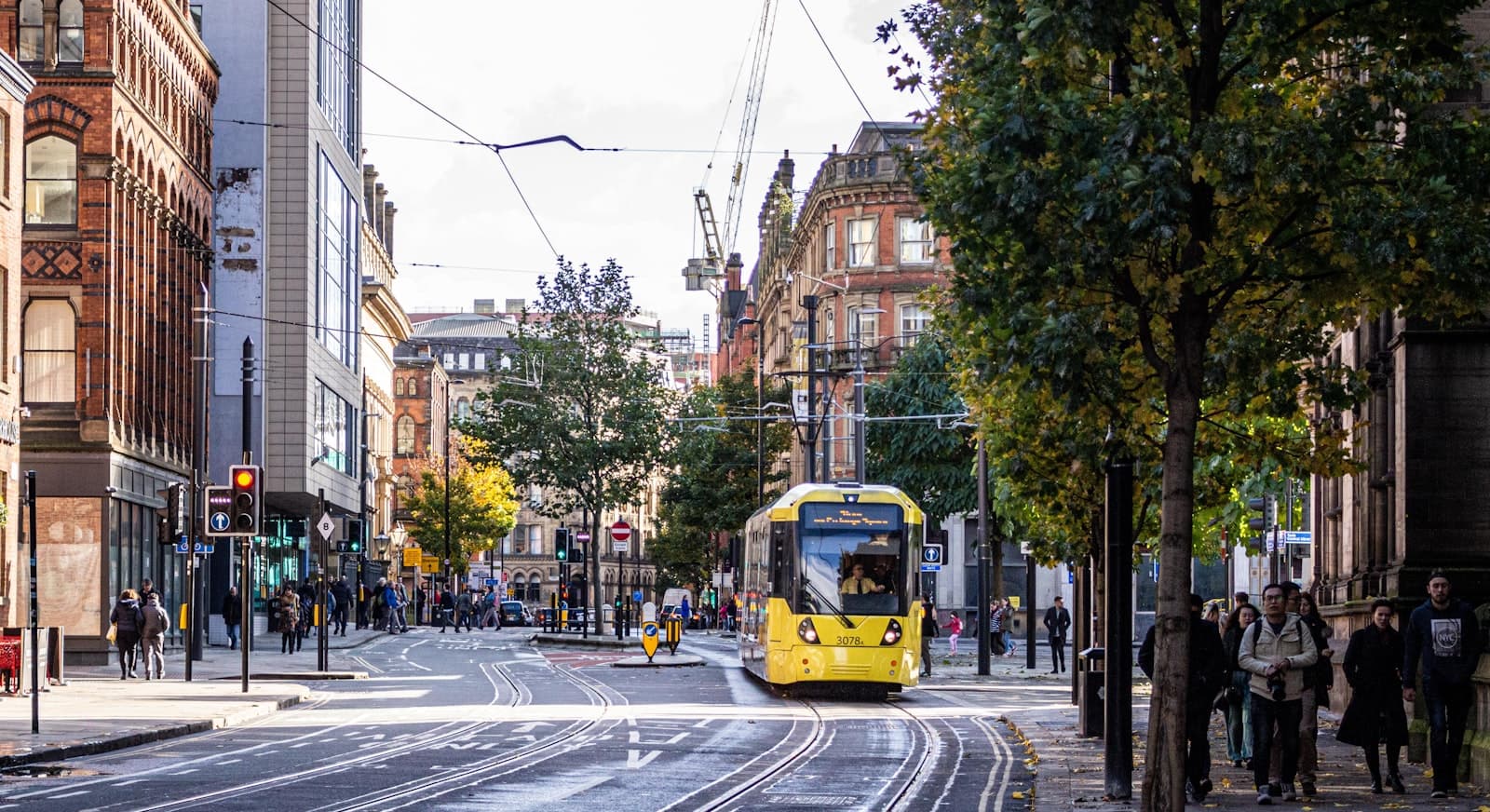
For most Greater Manchester businesses the right location targeting is the boroughs they serve, named one by one, with a small radius added only around a physical premises, and presence-only set so the ads show to people who are actually there. A single radius drawn from the city centre is the wrong shape: at ten miles it already reaches Warrington, which is in Cheshire, and at twenty it takes in Liverpool's suburbs, Blackburn and the Peak District. The county is a ring of towns, not a circle, and the targeting should follow the towns.
The three ways to draw the area
Google Ads lets you target by named location, by radius around a point, or by postcode. Named locations include the county, the ten metropolitan boroughs, the towns inside them and many districts. A radius is a circle in miles or kilometres around an address or a pin. Postcode targeting takes outward codes such as M20 or SK8 and is the most precise of the three. They can be mixed in one campaign, and excluded locations can be layered on top to cut a town out of a radius.
Our rule is that the shape should have a reason a customer would recognise. 'We cover Trafford and Stockport' is a reason. 'Fifteen miles from the office' is a number that happens to include Glossop, which the business has never visited. When a customer rings from a place the van does not go, the click was wasted and the customer was annoyed; a tighter area with a real reason beats a wide one every time.
The ten boroughs and the postcodes that cover them
Postcode areas in Greater Manchester do not follow borough boundaries, which trips up anyone who assumes M means Manchester and SK means Stockport. The table gives the main areas for each borough, with the overlaps that matter. Where a borough has districts in more than one postcode area, target by borough or town name first and use postcodes to trim.
| Borough | Main postcode areas | Notes for targeting |
|---|---|---|
| Manchester | M (most M1 to M23, M40, M90) | M90 is the airport; exclude it unless you serve travellers |
| Salford | M (M3, M5 to M7, M27, M28, M30, M38, M44, M50) | M50 is Salford Quays and MediaCityUK, a workplace postcode with few residents |
| Trafford | M (M16, M17, M31 to M33, M41) and WA14, WA15 | Altrincham and Hale are WA postcodes but firmly Greater Manchester |
| Stockport | SK (SK1 to SK8, SK12) and M19, M22 edges | Reddish is SK5; Poynton is SK12 and in Cheshire East |
| Tameside | SK14 to SK16, OL5 to OL7, M34, M43 | Denton and Droylsden are M postcodes inside Tameside |
| Oldham | OL1 to OL4, OL8, OL9 | Saddleworth villages are OL3; Chadderton is OL9 |
| Rochdale | OL10 to OL12, OL15, OL16 and M24 | Middleton is M24 but a Rochdale borough town |
| Bury | BL0, BL8, BL9 and M25, M26, M45 | Prestwich, Radcliffe and Whitefield are M postcodes; Ramsbottom is BL0 |
| Bolton | BL1 to BL7 | BL5 Westhoughton sits on the Wigan border and belongs to Bolton |
| Wigan | WN1 to WN8, WA3 and M29, M46 | Leigh and Golborne are WA3 but Greater Manchester; Warrington itself (WA1 to WA5) is Cheshire |
The Warrington point is worth repeating because it catches so many accounts. WA is the Warrington postcode area, and Altrincham, Hale, Leigh and Golborne all use it while sitting inside Greater Manchester. Targeting 'WA' as a whole buys Warrington, Widnes and Runcorn; targeting the individual WA3, WA14 and WA15 districts buys the Greater Manchester towns. Conversely, targeting 'Greater Manchester' as a named county already includes them, without the rest of Cheshire.
Presence, not interest
Whatever shape you draw, the location options setting decides whether the ad shows to people in it or to people interested in it. The default includes interest, and for a city with Old Trafford, the Etihad, an airport and the Christmas Markets, that is a large crowd of people elsewhere planning a visit. Set presence only on every campaign that serves a local customer. The exception is a hotel, a venue or a visitor attraction, which wants the interested searcher in Leeds precisely because they are coming.
How people here think about distance
Greater Manchester's residents measure distance in Metrolink lines and motorway junctions rather than miles. Someone in Altrincham thinks of Bury as far away though it is fourteen miles, because it is the other end of a tram line and the other side of the city; someone in Sale thinks of Salford Quays as close, because it is three stops. A business that draws its area to match those mental maps, the Altrincham line, the Bury line, the Eccles line, south of the M60, north of the M62, gets customers who already think of it as local. It is not a Google Ads setting, but it should shape which named locations go into the campaign.
Bid adjustments by place
Once a campaign has a few weeks of data, the locations report shows cost per conversion by borough, and the differences are usually large. A clinic in Didsbury might find Trafford converts at half the cost of the city centre because the searchers are residents rather than office workers passing through. Location bid adjustments let you pay more in the boroughs that convert and less in the ones that browse, without excluding anyone. With Smart Bidding the adjustments are advisory rather than absolute, but the report still tells you where to tighten the shape.
A worked shape for three kinds of business
- A tradesman in Stockport who covers south Manchester: Stockport, Trafford and Manchester as named boroughs, Tameside added if the van goes east, presence only, Wigan and Bolton not mentioned at all because they are not in the shape.
- A city-centre restaurant: a two-mile radius around the postcode, presence and interest both on for the visitor trade, plus named targeting for Salford and Trafford where the regulars live, and the ad schedule tied to service hours.
- A B2B supplier in Trafford Park that sells across the North West: Greater Manchester, Cheshire East, Cheshire West and Warrington as named locations, presence only, with the negative list doing the work of excluding students and job seekers rather than the map.
Location targeting is where a big-city account either respects the business's real reach or pays for the whole conurbation. Draw the shape from the map of where the vans go and the customers live, write down why, and check it against the locations report every month.
If you would like the shape drawn for your business, with the postcodes and boroughs named and the reasons written down, send us where you actually go.
Questions on this topic
Is Greater Manchester a targetable location in Google Ads?
Yes, as a county, and so are the ten boroughs and most towns inside them. Targeting the county is the quickest honest shape for a business that genuinely covers it; targeting boroughs is better for one that does not.
Should I use a radius at all?
Around a physical premises, a small one is useful: a few miles around a shop or a clinic catches the districts that have no named location of their own. As the only targeting for a service business, a radius almost always over-reaches.
Why does my ad show in Warrington when I targeted Manchester?
Usually because the location option includes people interested in Manchester, or because a radius reached it. Set presence only and check the map view of the radius. Warrington is close enough that a ten-mile circle from the centre touches it.
Can I exclude one town inside a borough?
Yes. Add the town as an excluded location, and the borough stays targeted around it. This is the right way to serve Salford but not Irlam, or Bury but not Ramsbottom.
Does the airport need excluding?
M90 is Manchester Airport's postcode and most searches from there are travellers. Unless you sell to them, exclude it. A taxi firm or a hotel wants it, a plumber does not.